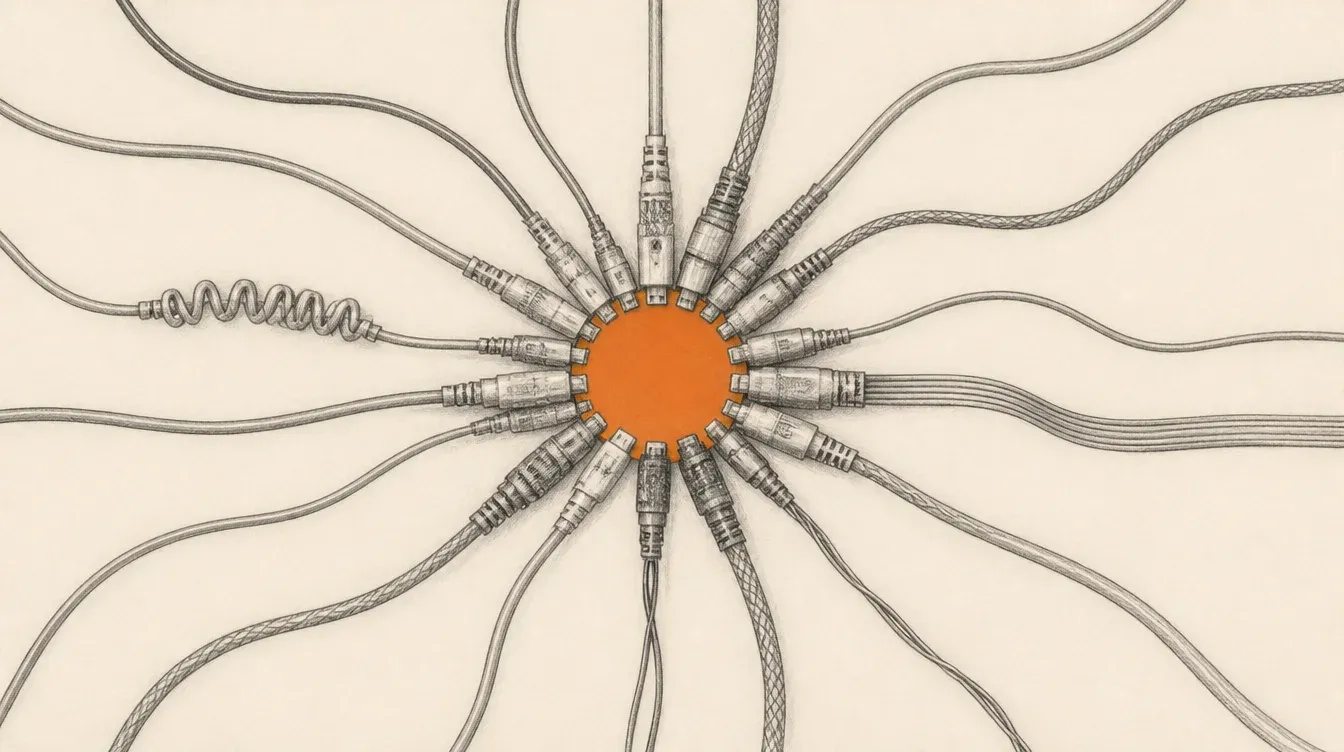
Your customer is one person, but your systems see five strangers: an email address in the mailing platform, a cart in the ecommerce store, a ticket in support, a phone number in WhatsApp and a row in the sales team’s spreadsheet. A CDP (Customer Data Platform) exists to fix exactly that: merge those identities into a single profile, keep it updated in real time and make it actionable.
What a CDP actually does
Three things, in this order:
- It unifies identities. It resolves that the person who opened the email, bought in the store and wrote on WhatsApp is the same human, even though each system knows them by a different identifier.
- It accumulates behavior. Every event (visit, purchase, open, message, refund) lands on the profile with its date and context. The profile is not a snapshot: it is the customer’s full movie.
- It activates channels. On top of those profiles you build segments that update themselves and flows that react to behavior: the abandoned cart, staged onboarding, dormant-customer reactivation.
That third point is what separates a CDP from a data warehouse: the warehouse stores and answers queries; the CDP also executes. If your data lives in silos that do not talk to each other, the CDP is the missing piece between having data and using it.
CDP vs CRM: the expensive confusion
The question we hear most: “I already have a CRM, why would I want a CDP?” The difference is structural:
- The CRM depends on human input. It records the commercial relationship: contacts, opportunities, meeting notes. If nobody types, there is no data.
- The CDP feeds itself. Every click, purchase and message arrives as an event without anyone typing anything, and becomes available in seconds for segmentation or triggering a message.
A B2B business with a long sales cycle lives in its CRM. A business with thousands of customers who buy, return and churn needs the CDP: no human team can log the behavior of 100,000 people. And they complement each other: the CRM usually connects as one more source of the profile.
The signs you already need one
- Every platform reports a different sales number and meetings are spent arguing about which one is real.
- Your campaigns send the same message to the customer who bought yesterday and the one who has not returned since 2023.
- The personalization you want requires “asking systems for the data” every time, and takes weeks.
- WhatsApp is your most effective channel but runs disconnected from everything else: nobody knows what conversation each customer had.
- The team has dashboards nobody uses to decide, because the data never reaches the daily operation.
How to implement one without dying trying
The classic fear is the never-ending project. Reality depends on method: with proven event schemas and a flow library, the Bigbox implementation was live in production in 15 days and later replicated across five countries. The order that works:
- Define the event schema in the business’s language (not the software’s).
- Connect sources in order of value: ecommerce first, then email, support and offline.
- Resolve identity across systems (the step nobody plans and everybody needs).
- Migrate existing flows first, then build the new ones.
- Measure against a control group from the very first flow.
Growth automation on a CDP is exactly that complete system: the platform is half the work; the daily operation on top of it is the other half, and it is where a CDP goes from installed software to a growth machine.