
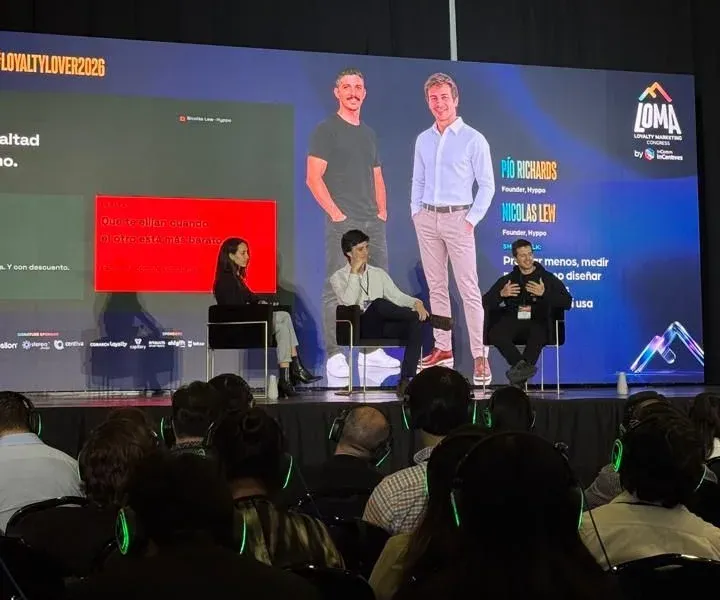
On September 29 we took the stage at the Loyalty Marketing Congress (LOMA) 2026, at the WTC in Mexico City, with a talk called “Reward less, measure better”. There were three of us: Pio Richards and me for Hyppo, and Talji Aziz, Head of Partnerships for Latin America at Customer.io, the platform we work on every day. This post is the written version of that half hour, for anyone who was not in the room and for anyone who was and wants the method at hand.
The thesis fits in one line: a loyalty program is not measured by redemptions, it is measured against a group that got nothing. Everything else is about getting to the point where you can run that comparison.
The question almost nobody can answer
We opened by asking the room: how much of what your members bought last year would have happened without the program? Not the redemption count, not active members. The incrementality number. Few hands went up, which is what we expected and what we see in almost every account we audit.
It is not a talent problem. Nobody asked for that number when the program was built. People asked for members, redemptions and engagement. Everything except causality.
The size of the problem
Public figures show how much value is in play without anyone knowing what it bought. Estimates from point.me and Switchfly (2025) put unredeemed points worldwide at around 35 trillion, more than a trillion dollars in circulation, with roughly 200 billion dollars a year ending up as breakage: points that expire and turn into accounting profit.
The clearest case sits in a public filing. Delta’s 10-K for fiscal 2024 reports a liability of about USD 8.8 billion in miles issued and not yet redeemed, and roughly USD 7.4 billion a year from its co-branded card agreement. The liability is measured with one number, which is why the CFO looks at it every quarter. The asset needs six: real usage, card revenue, incrementality, referrals, the data the program brings in and what people choose to redeem. Almost everyone measures the first two.
Three metrics that always go up
Redemptions, participation and redemption rate are real metrics, they are measured well and they are in every report, ours included. The problem is that they rise for reasons unrelated to the business:
- Redemptions go up if the reward is easy to use.
- Participation goes up if the promo is visible.
- Redemption rate goes up if the catalog is good.
All three can grow for a whole quarter without the program changing a single purchase decision. They show the mechanism works, not that the program pays. It is the same trap as last-click attribution: a metric that correlates with success is not proof that you caused it.
Retention is not loyalty
Underneath that confusion is an older one. Retention is people buying again, and you can get it with convenience, inertia or discounts. Loyalty is people choosing you when the competitor is cheaper, and points do not buy that. A program that mixes the two ends up paying every month for customers who were staying anyway and calling it loyalty. If you want to sort retention by customer stage first, our three-stage retention framework is the place to start.
The five-step method
The turn in the talk was this: the reward is not the goal, it is a tool. The goal is an experience worth living, repeating, recommending and sharing. When the experience holds up on its own, the reward stops buying behavior and starts underlining it, which is a much cheaper role. This is how we work it:
- Live the experience. Go through it end to end as a customer: book, wait, make a mistake, write to support on a Sunday. Almost every journey map is drawn from inside the company and describes the process, not the lived experience.
- Design the experience you want, in four moments: before (clear promise, short purchase), during (friction solved without anyone asking), when something fails (the alert arrives before the problem) and after (coming back is easier than starting over).
- Instrument the data. Unified identity across web, app and counter, complete and timely events, a single version of the profile, a signal ready to trigger something and an action at the right moment. As Talji put it, most programs do not have a creativity problem: they have a signal problem.
- Orchestrate. This is where the benefit finally appears.
- Measure against a control group.
From the 4 Ps to the 4 Cs
For step four, Talji proposed a change of vocabulary. The 4 Ps (product, price, place, promotion) work for a launch, not for a relationship that lasts years. In loyalty, four Cs matter: Content (what helps this person, not what is due this month), Customer (a behavior, not a list), Cue (the when: triggered by what they did, not by the calendar) and Channel (where they actually read, not where sending is cheapest). AI comes in as a decision layer inside that flow: it reads the signal live, picks the moment and gets ahead of friction before it becomes a complaint.
At an airline this is easy to see. A flight-change alert that arrives before the problem is worth more, in real loyalty, than triple points on that booking. That never shows up in a redemption report.
How to build a holdout that tells the truth
Measuring for real means having a group that gets nothing. There are four steps, and the last one is the hardest:
- Set it aside before launch, at random, and defined before you see a single result.
- Do not touch it. Not even a courtesy email: contamination ruins the read.
- Compare behavior, not redemptions. Purchases, frequency, tenure.
- Accept the result, especially when it comes back flat.
The first time a holdout is done properly, the same thing tends to happen: part of the lift being reported was people who would have come back anyway, and the program was handing them margin. It hurts, and it is the most valuable data point you will ever have about your program.
What you can measure and what you cannot
| What you want to know | Measurable? | How |
|---|---|---|
| Incrementality of a specific benefit | Yes | Random holdout with a fixed window |
| Effect of a new channel | Yes | Staggered rollout by geography or cohort |
| Value of the full experience | Partly | Approximated through tenure and frequency, not redemptions |
| Credit through last-touch attribution | Not useful | Credits the last one who spoke, not the one who persuaded |
Three questions for your program
We closed the talk with no conclusion, just three questions. They are the ones we ask before touching any program, and the same ones your board will ask when the year gets tight:
- Which group did you compare your last benefit against?
- Which experiment came back flat, and what did you do with that result?
- If we switched the program off tomorrow, how much would really drop?
If all three have an answer, you are ahead of most. If one does not, that is the one to work on first. It is what we do as a data marketing agency: instrument the signal, design the holdout and read the result even when it is not the one you hoped for.
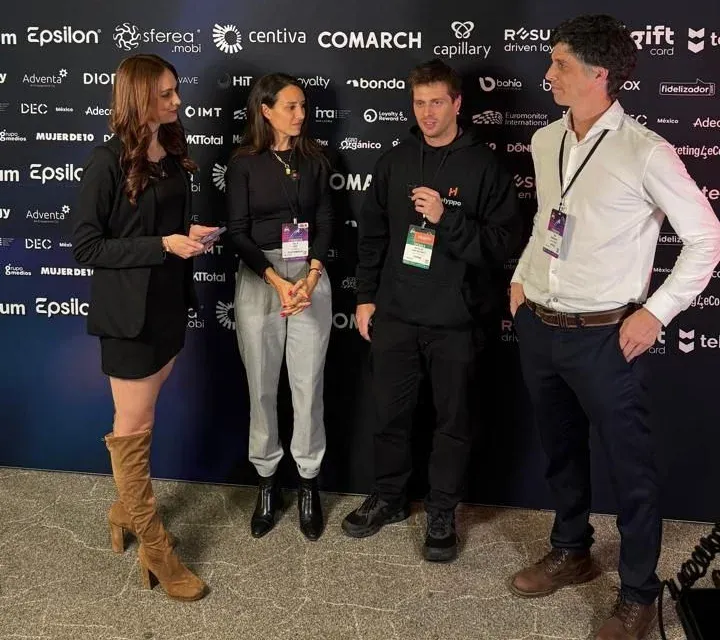
Thanks to the LOMA team for the stage, and to everyone who came by booth C-2 to keep the conversation going.