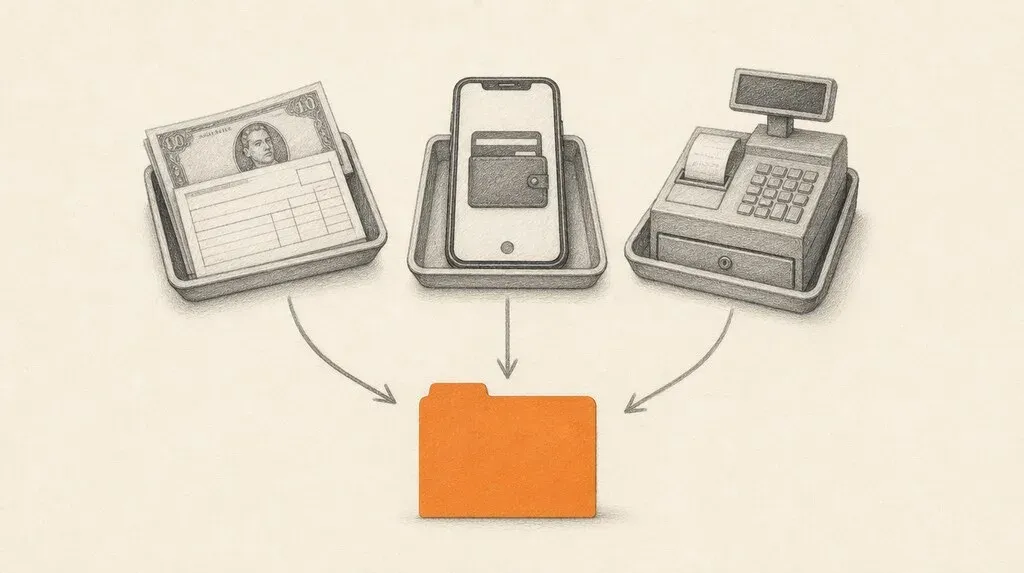
An institute or academy in Peru collects monthly tuition by bank deposit, by Yape or Plin, and at the front desk for the student who prefers to pay in person. Each channel makes sense on its own. The problem shows up at the end of the month, when administration builds the delinquency list from a single record and calls a student who, in reality, already paid.
Each channel sees its own payment, never all three together
The bank deposit arrives with a reference that sometimes carries the student’s name and sometimes does not. Yape and Plin identify the payer by phone number, but that record lives on the phone of whoever collects the payment, not in the administration system. The front desk logs the payment in a separate notebook, often with nothing more than the amount and the date. None of the three is badly designed for what it does. The problem is that nobody puts them side by side before deciding who to call.
It is the same split already covered in a business with two locations that never merges its customer records: there it was two stores with their own WhatsApp and their own Yape account; here it is three collection channels inside the same institute, with the same root failure.
The cost is not the unpaid balance, it is the call
A student who already paid by Yape and gets a collections call does not think “they have a systems problem.” They think the institute does not know what it has collected. The real unpaid balance, the one worth chasing, stays hidden behind that noise: the collections team spends the first calls of the month clearing up misunderstandings instead of talking to whoever actually owes.
How to match the three records without new software
- Ask for the student’s phone number on all three channels, not just Yape. On the bank deposit, make the transfer reference include the phone number or full name; at the front desk, log it next to the amount.
- Merge the three spreadsheets before building the delinquency list, not after. A shared spreadsheet is enough to start: sort by phone number and flag the matches across the three channels.
- Call the student who shows up unpaid in none of the three first. That is the real delinquency. Whoever paid on a channel collections never checked should not be on the list.
- Only then evaluate centralized collections software. It automates the match you already did by hand. It does not replace the work of deciding what data identifies the same student across all three channels.
It is the same principle that separates real dropout from a student who simply stops logging in: before acting on the student, confirm the data describing them is one single record. In data marketing for institutions in Peru, that is where the work starts: matching what each collection channel already knows before touching the collections process itself.
If your institute collects through more than one channel and you have never matched the three records, you are probably calling students this month who already paid.