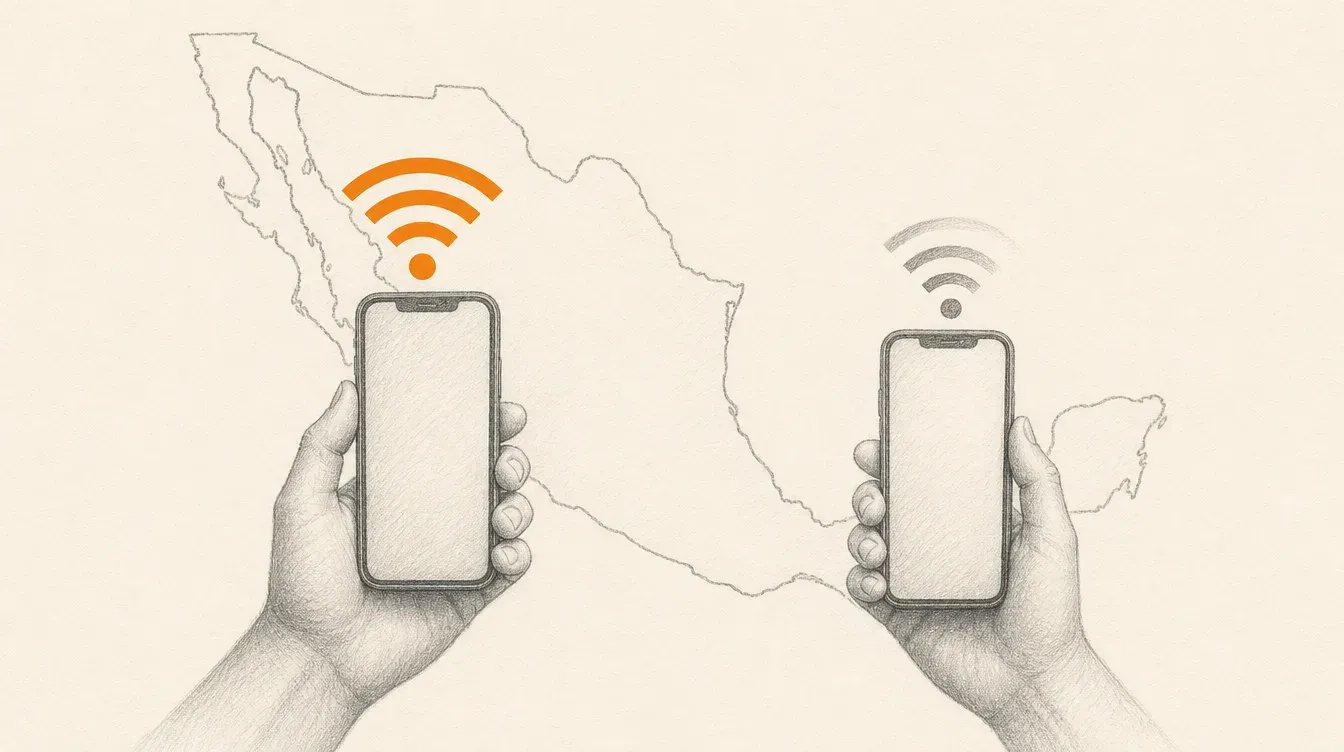
Your campaign reaches nearly all of Mexico’s population: 86.1% already use the internet, per INEGI. But reaching someone is not the same as selling to them. Mexico’s urban-rural gap in online purchases is wider than its gap in plain internet access, and that is where a national campaign starts failing without the reach report ever showing it.
Access is almost no longer the gap
In 2025, 86.1% of the Mexican population aged 6 and up used the internet (104.9 million people), per the Encuesta Nacional sobre Disponibilidad y Uso de Tecnologías de la Información en los Hogares (ENDUTIH), run by INEGI. The gap between urban and rural areas is 13.7 percentage points (88.9% against 75.2%). 78.3% of households already have a connection, double the share from a decade ago. By that measure, Mexico is nearly connected end to end, with Mexico City, Nuevo León, and Baja California leading.
Where the gap actually shows up: buying and paying, not browsing
The same study measures something else, less often cited. Of all the internet uses it measured, the ones with the widest urban-rural gap are not browsing or social media: they are paying online (21.7 percentage points) and buying products or services online (20.9 points), followed by online banking (20.7 points). All three gaps are wider than the general access gap. Someone connected in a rural area still buys and pays online noticeably less than someone connected in a major city.
What changes for a campaign that measures national reach
A report that only tracks impressions, clicks, or visits can look even across regions, because that is where the access gap (13.7 points) has nearly closed. The problem shows up a step later, in how many of those visits end in a completed purchase and payment. It is the same logic behind measuring how a campaign changes outside the capital in Peru: access is not the only filter, and sometimes it is not even the biggest one.
Three places worth measuring that gap separately, instead of a single national average:
- The payment method offered by region. If your checkout defaults to card only, check how much of that 21.7-point gap traces back to a lack of alternatives like cash payment in areas with lower banking penetration.
- The campaign message. In a region with less online purchase history, a message that lowers the friction of a first purchase (clear guarantee, easy return) works better than the same quick-repurchase message that works in a major city.
- The result you report. Split reach from conversion by region, instead of a single national average that blends a high-converting city with an area that still does not convert the same way.
If your campaign reaches the whole country evenly but sells unevenly, the problem is not reach: it is one step later, in the purchase and the payment. Measuring that gap separately is the first step of the work we do in data marketing in Mexico: before adjusting the message, it helps to know exactly where in the funnel the sale is actually getting filtered out.