Paid media

Programmatic Media Buying in Mexico: Reach Is Not Enough Without Your Own Data

Programmatic media buying is an automated auction that decides, in milliseconds, who sees an ad. Without audiences built from first-party data (recent buyers, cart abandoners, high-LTV customers), the platform optimizes on generic signals: it buys reach, not customers, and shows the ad again to people who already are one.

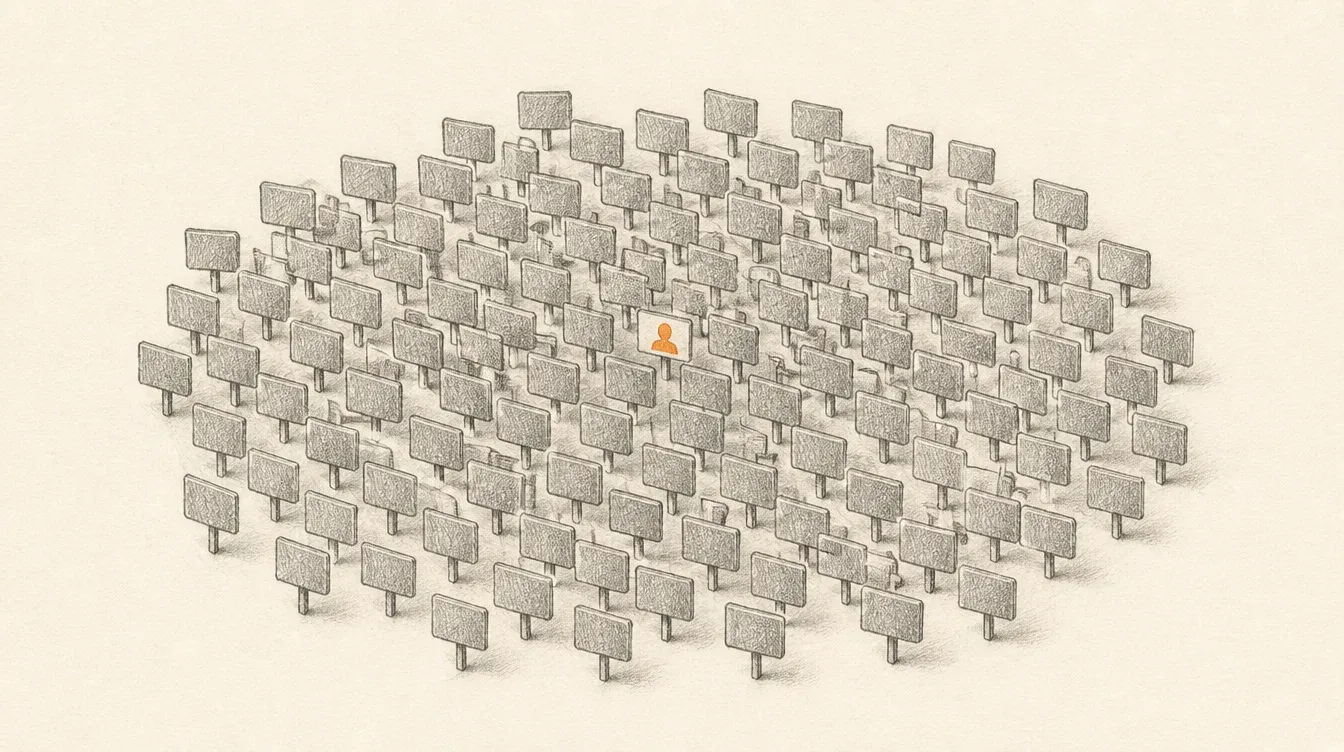
A field of identical graphite signboards, all grey and blank except one in the center marked with a person silhouette in solid orange

What matters

  • Programmatic buying is an automated auction (RTB) that decides in milliseconds who sees an ad, not a campaign built channel by channel by hand.
  • Without first-party audiences, the platform optimizes on generic signals and ends up showing the ad to someone who is already a customer.
  • Measuring only impressions hides whether a campaign generated a sale that would not have happened anyway: what matters is incremental impact, not reach.
  • Crossing the campaign exclusion list with the customer base stops you from paying for an ad shown to someone you are already reaching on WhatsApp or email.

A marketing team in Mexico turns on a programmatic buying campaign expecting scale: thousands of sites, apps and video slots available under a single budget, with no per-publisher negotiation. They turn it on, spend, watch impressions climb. Three weeks later cost per acquisition has not moved, and nobody on the team can say with certainty who the ad actually reached, beyond the summary the platform itself hands back.

What programmatic buying actually purchases

It is an automated auction (RTB, real-time bidding): an algorithm decides, in milliseconds and for every available impression, who sees an ad and how much to pay for that specific impression. There is no person negotiating space with each publisher, there is a platform optimizing on whatever signals it has on hand: page context, device type and, carrying less weight every year, third-party cookies. The problem is not the auction itself: it is what feeds it. When the only signals available are generic (age, location, site category), the result is broad, low-relevance reach. The platform is paying for impressions, not for audiences the business already knows.

What you need before turning the campaign on

  1. Audiences built from first-party data. Who bought in the last 30 days, who abandoned a cart, who has high lifetime value. Without this, the platform buys impressions blind and shows the same product again to someone who already bought it last week.
  2. Incremental measurement, not just impressions. A report that only counts reach cannot say whether a sale would have happened anyway. The same blind spot behind last-click attribution models applies here: before scaling budget, confirm how much of the sale is genuinely attributable to the campaign, not just claimed by it.
  3. Cross-channel exclusion. If the ecommerce platform, the CRM and WhatsApp each hold a different version of the same customer, the programmatic campaign has no way of knowing that person is already being reached somewhere else. That single view of the customer is exactly what a CDP is for: without it, every system decides with a third of the story.

None of these three points is a feature the programmatic platform sells you. They are data the business already has, generated by its own operation, that rarely arrives packaged as an audience before the campaign goes live.

If your programmatic buying in Mexico shows rising impressions and a flat cost per acquisition, it is probably not a budget or creative problem. It is the same data diagnostic we run before touching any paid channel: confirm what the campaign actually knows about the customer before asking it to bring in more.

Frequently asked questions

What is programmatic media buying?

It is the automated purchase of ad space (sites, apps, video, streaming) through a real-time auction: an algorithm decides, in milliseconds and for each available impression, who sees the ad and how much to pay for that specific impression, instead of negotiating space manually with each publisher.

Why does programmatic buying in Mexico not always lower cost per acquisition?

Because the algorithm optimizes on the signals it has available. If those signals are generic (age, location, site category) instead of first-party business data, the result is broad but low-relevance reach: part of the budget ends up showing the ad to people who are already customers or already bought.

What data do I need before scaling a programmatic campaign?

Audiences built from first-party data: who bought in the last 30 days, who abandoned a cart, who has high lifetime value. Those lists feed both targeting (who should see the ad) and exclusion (who should not see it again), and they are exactly what the platform does not have on its own.

Keep reading

Data & measurement 2 min read

Attribution models: why last click is lying to you

Last click gives all the credit to the channel that closes and none to the one that created the demand. What each model rewards and which one fits your decision.

AI & automation 3 min read

What a CDP is and when your business needs one

A CDP unifies every customer interaction into a single actionable profile. What it actually does, how it differs from a CRM, and the signs your business already needs one.

All topics

×
Hi! 👋

How can we help you today?

Please write a message first.